
EN

"The operators who are actually next to the machine are the ones who really know the process. We can have all the theoretical knowledge, but the practical part lives with them."
21.07.2026
A Biochemist in a Textile Factory
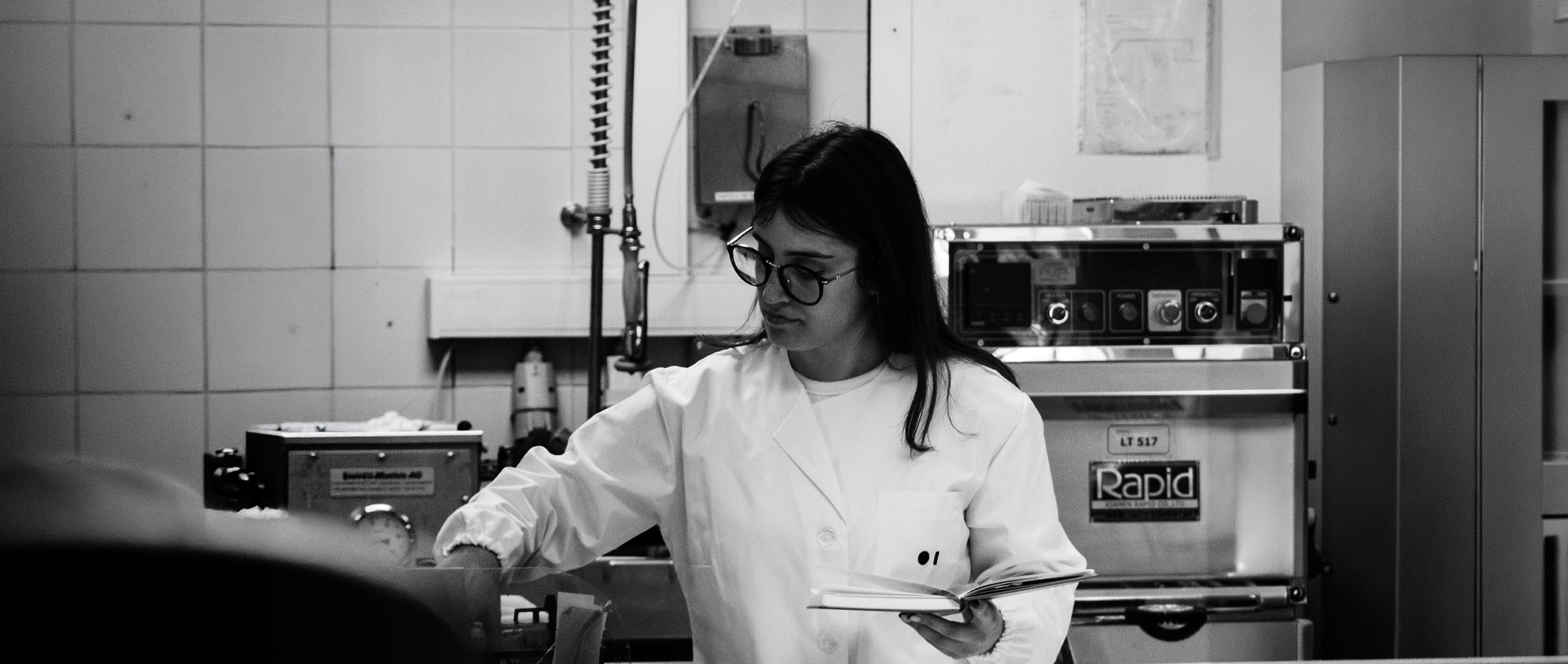
Margarida Alves didn't take the obvious path. Her academic background is in biochemistry. Not textile engineering, not industrial processes. When she arrived at Adalberto in 2022 as a master's student writing her thesis, she was stepping into a world she had never worked in before.
She stayed for six months to finish her dissertation. Then the company asked her to stay permanently, as part of the process engineering team, focused on the dyeing department.
"Coming from academia into an industrial environment was a completely new world. I even joke that this was almost like a third degree for me. My base is biochemistry, nothing to do with textiles. Being here at Adalberto was almost a third school. And I feel I've evolved enormously since 2022."
Between the Lab and the Floor
Process engineering at Adalberto sits between two worlds. On one side, the laboratory: analysis, testing, technical knowledge. On the other, the production floor: machines running, operators working, fabric moving. Margarida moves between both, every day.
"Technically, we are learning every day because what was true yesterday may not be true today. But the relationship side, that is what matters most on a daily basis. The operators beside the machines are the ones who truly know the process. We, as the technical team, can have a lot of theoretical knowledge but the practical knowledge belongs to them. It is a mix of both: the people on the floor who know the practice, and us technicians who know the theory."
This balance, between knowing and listening, between the spec sheet and the instinct of someone who has run the same machine for years. Is at the heart of what process engineering does. It is not about telling people what to do. It is about understanding what they already know, and building on it.
When Something Goes Wrong
In a production environment, things go wrong. Fabrics come out differently than expected. A process that worked yesterday produces a different result today. When that happens, the investigation begins.
"When an anomalous situation appears, it normally shows up in the quality of the articles. First we try to find a corrective action in the moment, to contain the problem. But beyond that, we have to understand the root cause, whether it was a one-off situation or something recurring. If it's recurring, it's almost certain that something in the process is failing."
And sometimes, the cause is not obvious. Sometimes the only way to find it is to deliberately recreate the problema, to provoke the error in a controlled way, to see what triggers it.
"There are things where we say 'ah, it's this', partly by intuition, from what has happened before. And there are new things where we have to really understand why it happened. And from there, find preventive actions so it doesn't happen again."
Building Trust on the Floor
Proposing changes to a process that has been running a certain way for years is not always straightforward. People know their machines. They have done things their way for a long time. Walking in with a new approach requires more than technical knowledge. It requires trust.
"There's no point arriving next to an operator and saying 'you have to do this.' If he doesn't feel involved, if he doesn't feel heard, he will very rarely do it willingly, especially if it's different from what he's used to. So first, I explain what we want to achieve, what the objective is. And then I listen to what he suggests, because he has enormous practical knowledge of the machine and the process."
This approach has shaped how Margarida works. On a current project in the dyeing department, the collaboration with the operators has been, in her words, fundamental.
On Being a Woman on the Production Floor
Margarida is one of the few women in a technical role on the production floor at Adalberto. When asked whether that has shaped the way she works or builds authority, her answer is direct.
"I think the answer is the same as before. It comes down to communication, whether you're a woman or a man. Perhaps sometimes we women have to make ourselves heard a little more. But here, I've never really felt that. I've always felt listened to by the operators. It comes down to communication: explaining what you want to do, listening, and empathy, a lot of empathy for the operator who is there for eight hours beside that machine and knows it better than I do."
Still Learning. Still Here.
Three years in, Margarida Alves describes herself as happy at Adalberto, but not completely. She says that with a smile, not a complaint.
"I don't think anyone is ever completely happy. But it's the environment that shapes your day. And here I feel part of something, in the dyeing department, in other sections too. I feel involved, and I feel I have the support of the people around me."
Inside the Machines is a series of eight conversations with the people behind Adalberto Textile Solutions.





© 2024 Adalberto Textile Solutions. All rights reserved.