
EN

"A minimum oversight, one mistake and everything goes back to the beginning. That can't happen."
26.06.2026
39 Years on the Finishing Floor and Still Walking
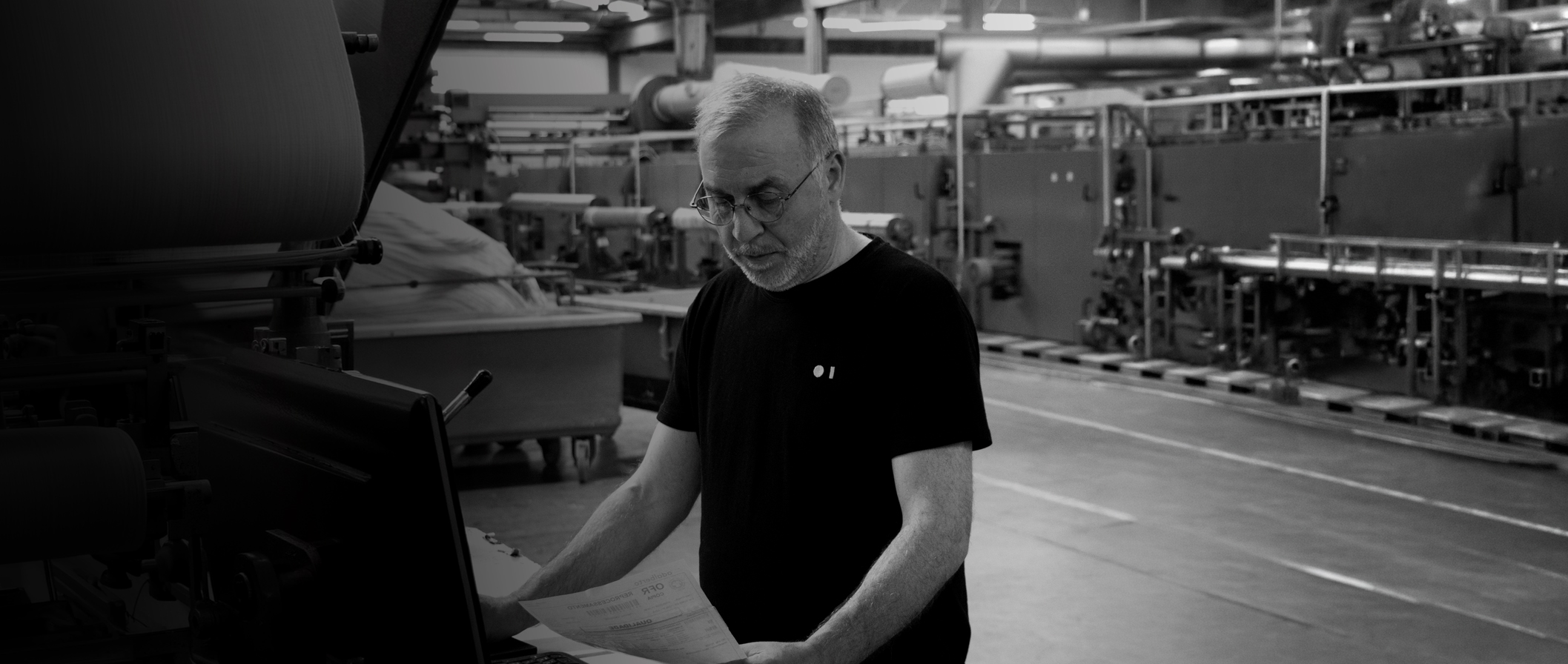
Luís Cunha has been at Adalberto since 1987. He started on an old knit-opening machine, moved to finishing when a new machine arrived and someone pointed at him, and never left. Today he oversees the last step before fabric reaches the client. The stage where everything either holds together or falls apart. In 39 years, he has learned that the difference between the two often comes down to a single touch.
It Happened One Machine at a Time
When Luís arrived at Adalberto, they put him on a knit-opening machine. He spent a year or two there, learning what the fabric needed and what the machine could give. Then a new finishing machine arrived and his supervisor told him he was moving.
"I spent four or five years on that machine. Then I was invited to lead everything. Of course I accepted."
It wasn't a dramatic moment. It was simply the next step earned through years of showing up, paying attention, and doing the work properly. That is still, 39 years later, how Luís Cunha leads.
The Last Step Is the Most Unforgiving
Finishing sits at the end of the production line. Every metre of fabric that passes through this department has already travelled through preparation, dyeing, and printing. It has been washed, coloured, and sometimes printed. By the time it reaches finishing, it is close to its final form and it is here that the last decisions are made about how it will look, feel, and behave in the hands of whoever buys it.
There is no room for error at this stage. A mistake in finishing has nowhere to go except back to the beginning.
"The most important thing is always to serve the end client well. We have to get it right the first time because if we don't, the costs go up and the delivery delays start. Today, meeting deadlines is everything."
Luís starts every morning the same way. Before anything else, he finds the night shift supervisor and gets the handover. What ran. What didn't. What needs his attention. Then he starts walking.
"They say I walk kilometres here. I can't stay still for five or ten minutes. Everything has to pass through my hands. I'm very much a perfectionist. I can't let things go wrong."
What the Hands Know
In finishing, quality control is partly technical and partly something else entirely. Something that lives in the body rather than in a specification sheet.
Shine is checked visually. The supervisor looks at the fabric against the client's sample, reading the surface for the exact level of reflection that was approved. The handle is checked by touch. There are knits that need to break, a specific give, a particular softness and the only way to know if it is right is to hold the fabric and feel what it does.
"With shine, you look at the fabric and check if it's giving the reflection that matches the client's sample. With handle, there are knits where you want it to break. You hold the fabric and feel it give in your hands. Just by touching it, you already know."
This is knowledge that accumulates slowly. It cannot be written into a manual or transferred in a training session. It is built over thousands of metres of fabric, over years of feeling what is right and what is not. Luís Cunha has been building it since 1987.
When the Pressure Arrives
Finishing is where the pressure of the entire production line lands. If dyeing ran late, if printing had a problem, if anything upstream took longer than it should, all of that arrives at the finishing department compressed, with the same client deadline still waiting on the other side.
These are the moments that test a team.
"If there were already delays behind us and we fail then everything is wrong. We have to be fully focused, motivate the team around the problem, make sure they understand what's at stake. A client might not accept our orders again. That's what we can't afford."
Not with pressure or urgency alone, but with the clarity of someone who has been through this before and knows exactly what needs to happen next.
Three Generations. One Constant.
Luís Cunha has worked under three generations of the family that built Adalberto. He knew Dona Noémia: precise, attentive to every cost, every detail. He worked through the years that followed. And now, under Jorge Adalberto, he sees a company changing its rhythm.
"Back then, everything was made to stock. Fabric was prepared and stored, ready for when orders arrived. Today an article comes in and three or four days later it's already at the client. It's completely different. And I think the company is investing and evolving right now. We have to."
Three generations. Three different ways of running a business. The factory around him has changed. The machines, the pace, the market. What hasn't changed is Luís Cunha, walking the floor every morning, picking up a piece of fabric, and feeling whether it's right.
"I like what I do. That's why I'm still here. We have to be happy in what we do, because if we work against our will, it simply doesn't work."
Inside the Machines is a series of eight conversations with the people behind Adalberto Textile Solutions.





© 2024 Adalberto Textile Solutions. All rights reserved.